
Liquid analysis
SpectroCuvette™
One
Label-free protein and concentration measurements from 0.5 μL — in the UV-Vis spectrophotometer you already have.
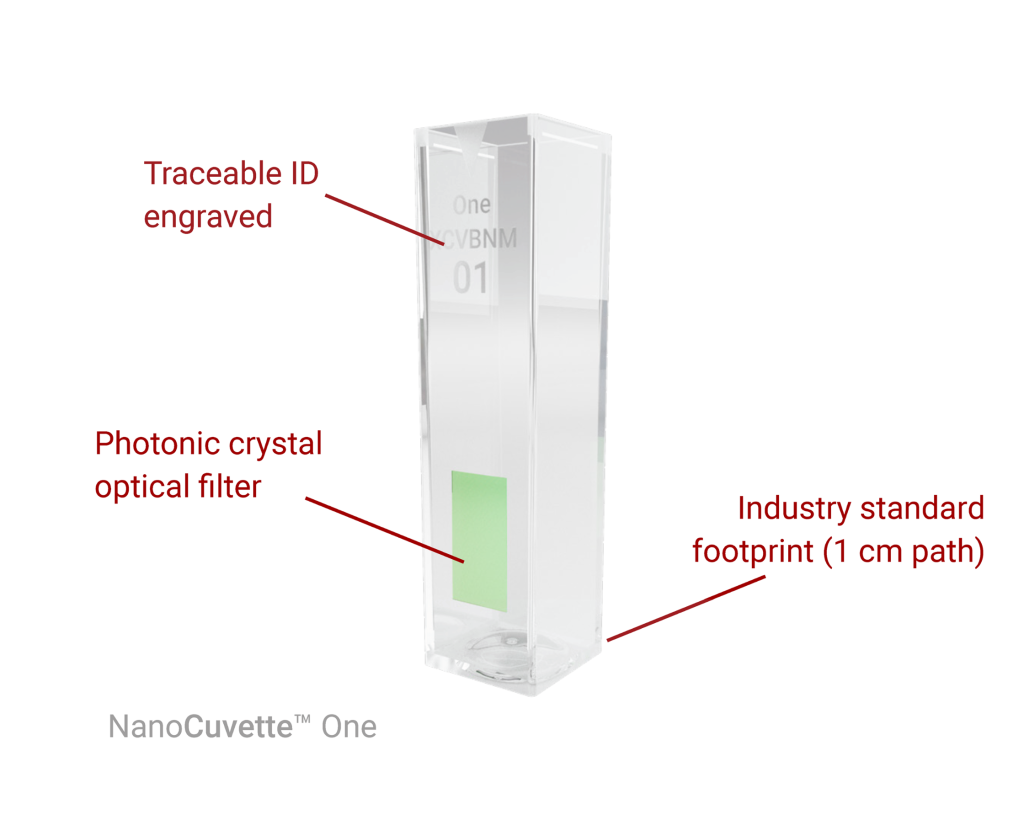
The cuvette
Next-gen Quantitative Analysis
The SpectroCuvette™ One is an excellent improvement in any laboratory workflow for quantitative analysis in numerous industries such as biotechnology, pharmaceuticals, chemistry, foods and industrial applications for quality control.
The capacity of SpectroCuvette™ One goes far beyond any product currently on the market in terms of concentration determination. With the SpectroCuvette™ One you are able to analyze smaller samples (down to 0.5 μL) and a large range of concentrations (0.02–300 mg/mL) of non-absorbing compounds.
Documentation
Photonic crystal
Expanding Capabilities
The SpectroCuvette™ One expands the capabilities of your spectrophotometer. It allows you to perform classic absorbance (attenuance) spectroscopy and label-free spectroscopy via refractive index.
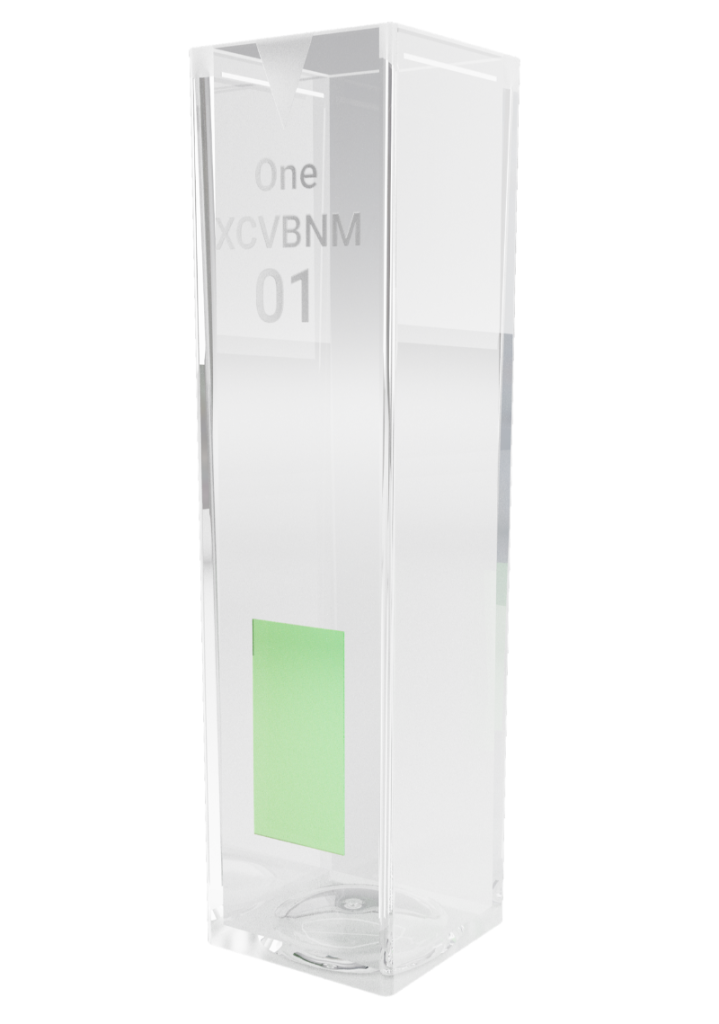
Integrated in the surface is a patented photonic nanocrystal (optical filter), which bends the light beam such that it senses refractive index near the photonic crystal surface in the wavelength range from 550 nm to 800 nm.
Why Upgrade
Traditionally, spectrophotometry laboratory work has been limited by lack of robust methods to determine concentrations. We upgrade UV-Vis spectrophotometry around the world and across all major instrument brands to create new ways to determine concentration, perform enzymatic studies in a label-free, fast, cheap, and reliable method.
Technology: How We Do It
Absorption versus label-free spectroscopy
With absorption spectroscopy, the Beer–Lambert law relates the attenuation of light to the properties of the material through which the light is traveling:
A = εcl + A0
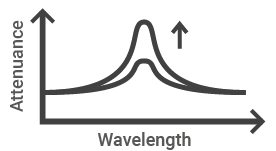
where A is the absorbance, ε is molar extinction coefficient, c is the concentration, l is the path length and A0 is the background absorbance.
Lambert, J.H. (1760). Photometria sive de mensura et gradibus luminis, colorum et umbrae. Augsburg: Eberhardt Klett. Beer (1852). Bestimmung der Absorption des rothen Lichts in farbigen Flüssigkeiten. Annalen der Physik und Chemie, 162(5), 78–88.
In contrast, when light hits a nanoscale photonic crystal, the resonance wavelength is related to the refractive index or concentration close to the surface:
λ = β(αc + ns) + λ0
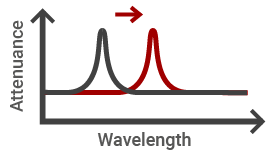
where λ is the wavelength, β is a coefficient, α is the specific refractive increment, c is the concentration, ns is the solvent refractive index and λ0 is the reference resonance wavelength, derived from Snell’s law. In this application this is called label-free spectroscopy.
Nano Lett. 2014, 14, 8, 4499–4504. Højlund-Nielsen et al. (2016). Plasmonic Colors: Toward Mass Production of Metasurfaces. Adv. Mater. Technol., 1: 1600054.
Key Uses
Lift the Standard of Lab Analysis
- Measurements at different volumes (0.5 μL–3 mL) and concentrations (0.02–300 mg/mL)
- Non-absorbing protein concentrations
- Monitoring label-free enzymatic reactions
- Monitoring non-absorbing/non-fluorescent kinetics
- QC measurements
Less Sample Needed for Analysis
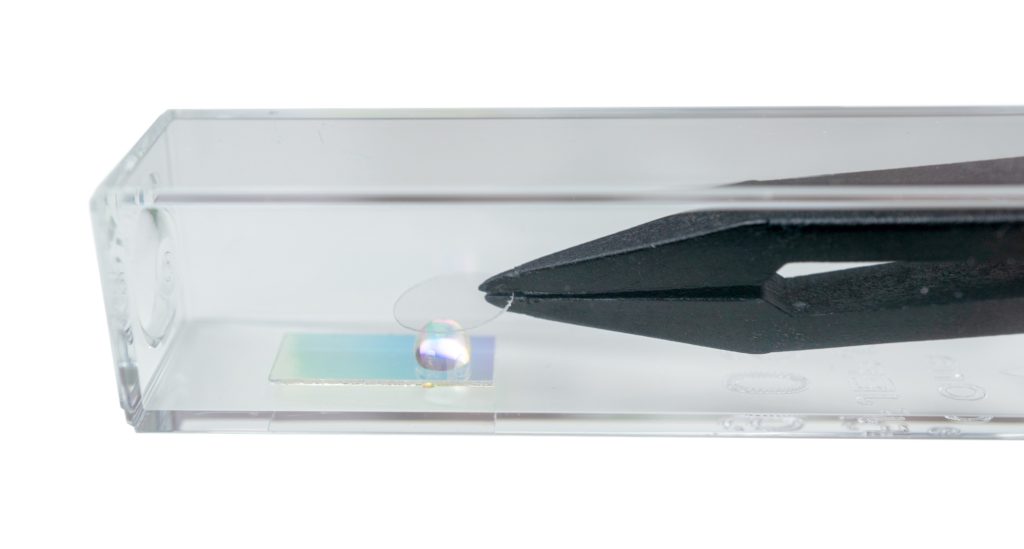
Enzymes and proteins can be expensive; some equipment needs 2–3 μL to measure protein. The SpectroCuvette™ One can measure volumes down to 0.5 μL and concentrations down to 0.2 mg/mL for sucrose (limit of detection is below 0.2 mg/mL sucrose concentration).
Label-Free Everything
Micro-Volume Protein Concentration Determination
SpectroCuvette™ One’s optical filter measures refractive index and together with SpectroWorks™ it will calculate the refractive index similar to SPR. Refractive index does not require any coloration (dye or indicator) to be measured. Thus it is possible to measure concentrations with a spectrophotometer of a transparent solution.
Application example: Micro-volume 0.5 μL BSA triplicate measurements
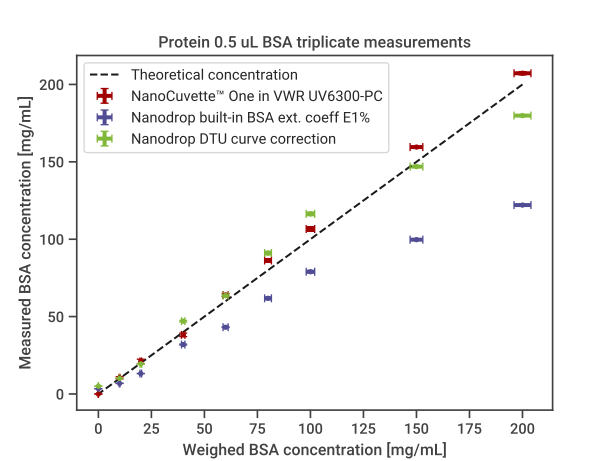
Example case: Kinetics, nanodrop replacement for proteins.
Ideal for bio-tech, life science and university labs.
Protein Concentration Determination
Some proteins can be quantified by absorption spectroscopy as aromatic amino acids absorb UV light at 280 nm. Depending on the amount of protein it will absorb more or less light at 280 nm and have a higher or lower extinction coefficient. The extinction coefficient can be calculated theoretically, but these values are often off by 10% or more. With label-free spectroscopy the extinction coefficient has been determined with high precision. The protein refractive index is a quick way of obtaining the protein concentration without the need of making a standard curve. As an additional advantage, this method also allows for direct quantification of your protein without prior dilution.
Application example: 3 mL BSA triplicate measurements
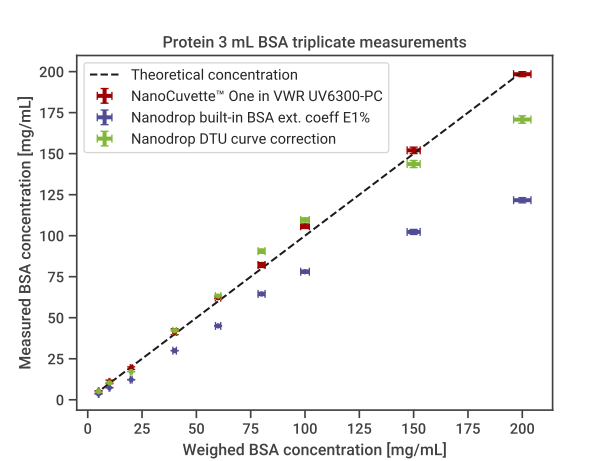
Example applications: BSA, Immunoglobulin, Collagen, Lysozyme, Coronin, Dystrophin, Gloverin, Keratin, Myosin, Tubulin, Insulin, concentration of protein in urine.
Ideal for bio-tech, life science, food science industry, high schools, environmental research, university and research laboratories.
*Khatri S. et al. (2021). White paper: Protein quantification using spectrophotometer, SpectroCuvette™ One and SpectroWorks™ compared to micro-volume system. Alontia, Copenhagen (Denmark). Technical University of Denmark, Department of Chemistry.
Monitoring Label-Free Enzymatic Reactions
Direct label-free detection of enzymatic activity with a substrate can be monitored with the change in the intrinsic property refractive index of the solution as product is formed over time. The SpectroCuvette™ One has a built-in optical filter allowing it to measure refractive index changes due to enzymatic reaction kinetics in real time using an UV-Vis spectrophotometer.
Superior Technology with no Up-front Cost or Training for Your Lab
Key Features
-
Supports your hardware
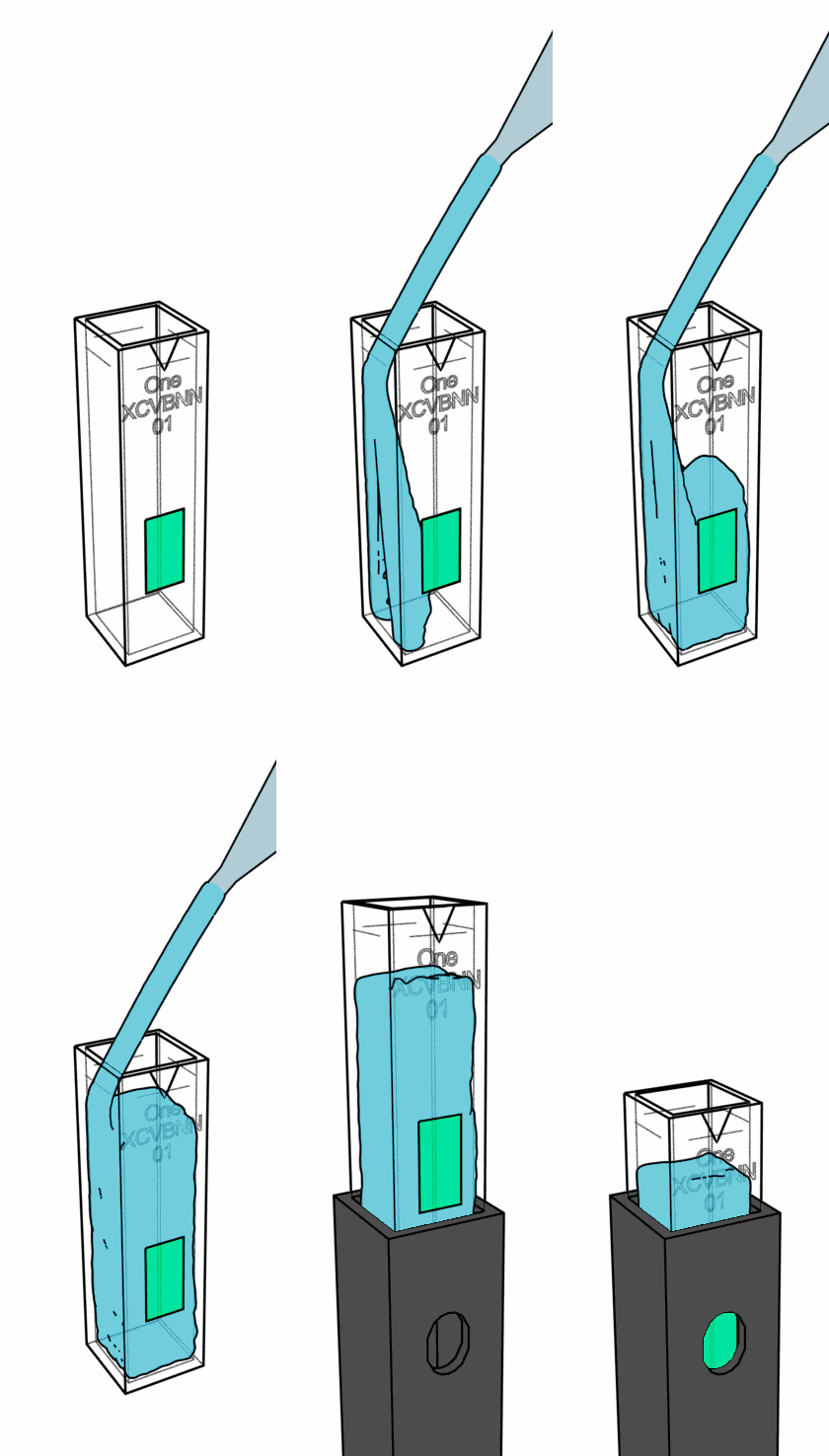
SpectroCuvette™ One likely works with your existing UV-Vis spectrophotometer.
-
Designed for humans
Easy to use with no special training required. Online support included.
-
Accurate and instant results
Results are calculated based on spectral analysis. Our engine in SpectroWorks™ is fast and makes it a breeze to extract results.
-
Unique traceability
First in the industry, each cuvette is marked for traceability and access to online calibration data.
-
Semi-reusable cuvettes
The SpectroCuvettes™ can be re-used up to a certain amount depending on application and maintenance.
-
Less sample needed for analysis
Measurements at different volumes (0.5 μL–3 mL) and concentrations (0.02–300 mg/mL).






Your Expert in UV-Vis Technology
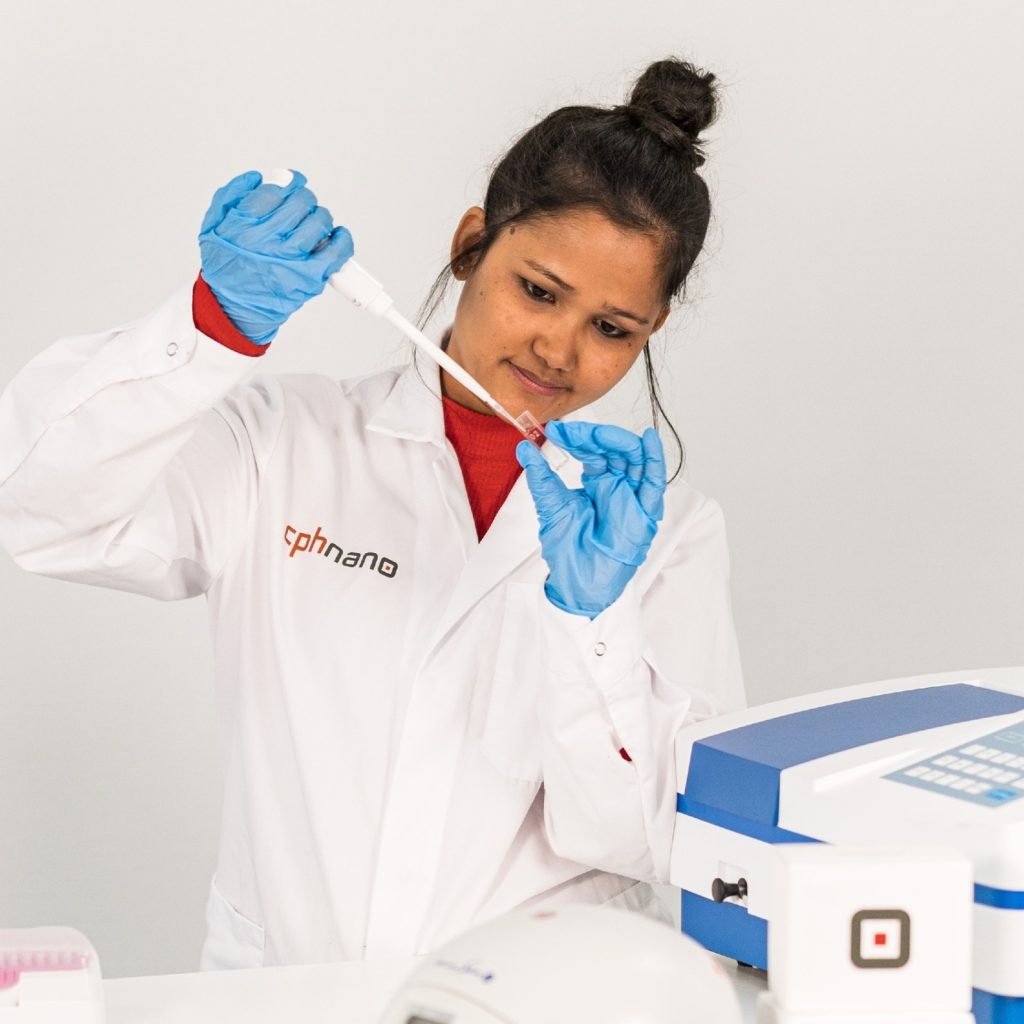
Need help getting started? We have got you covered.
*Purchase of SpectroCuvette™ One at a reseller includes lifetime access, data storage and quarterly upgrades to SpectroWorks™, free support and individual calibration for best performance. Price per measurement may vary depending on sample and use.